News
News List, News Categories, Events
-
Public Book Awards 2017: 4 books by Ikaros on the shortlists for the best of the year!
The first phase of voting for the 2017 Public Book Awards concluded with 148,949 votes, during which readers selected their favourite books from 9 different categories.Four books from Ikaros have been shortlisted among the best books of the year!See the nominations for our books (by category) along with the links for each one and vote for them as the top books of the year by Sunday 21 May! Greek novel:Eftychia Giannaki – In the Back Seat: http://bit.ly/StoPisoKathisma17 Greek short story:Dimitris Nollas – Stories Are Always Foreign: http://bit.ly/OiIstoriesEinaiPantaXenes17 Poetry:Kiki Dimoula – Semicolon: http://bit.ly/AnoTeleia17Κώστας Bournazakis – Faces and Trials: http://bit.ly/ProsopaKaiDokimasies17Learn more
-
Children's book
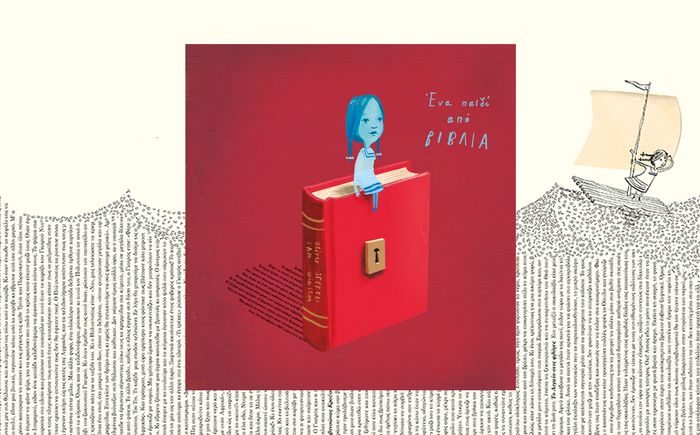
Ikaros Publications are celebrating World Children’s Book Day 2017 with a child made of books!
Ikaros Publications is celebrating World Children’s Book Day 2017 (2 April) with the release of the fairy tale A Child Made of Books, a book that pays tribute to the power of children’s literature and storytelling, by the award-winning storyteller Oliver Jeffers and illustrator Sam Winston, translated by Filippos Mandilaras.“What we wanted from the outset was to create a story that would speak of our love for classic children’s literature in a modern way,” say the authors.The celebration of World Children’s Book Day each year is nothing less than an opportunity to realise the vital role that children’s reading plays at a young age, shaping children’s future character. A book dedicated to children’s literature is the ideal way to mark this day. A girl made of books sails in her raft across a sea of words until she reaches a boy’s house. She invites him to join her on an adventure in the world of stories, where anything can happen with the power of imagination.A Child of Books brilliantly combines Oliver Jeffers’ handwritten texts with Sam Winston’s distinctive visual elements, crafted from phrases taken from forty classic fairy tales. The result is a lavish edition that invites readers of all ages to discover, to wonder and, with imagination as their main weapon, to dream. After all, imagination belongs to everyone! The creators talk about the creation and publication of the book: Sketch from the cover design process REVIEWS‘The unique artistic collaboration between Jeffers and Winston, with its inventive combination of watercolour, pencil and digital collage, immediately captures the reader’s attention. Jeffers’ hand-drawn, asymmetrical text contrasts with Winston’s digital design lines, which incorporate passages from classic works of children’s literature... A brilliantly clever quest for literary delight.”Kirkus Reviews ‘...a fresh and exciting collaboration between two talented creators.’ The New York Times ‘Every element of the book—its captivating hand-drawn texts, the illustrations created with watercolour, pencil and digital collage, as well as the objects made from phrases from classic fairy tales—contribute to a lavish edition that is perfectly harmonious as a whole.”Booklist “Jeffers and illustrator Winston collaborate on a book that is a hymn to the power of imagination, in which distinctive pen-and-ink sketches meet objects crafted from the text of classic books... The power of the images leaps off the pages, because imagination belongs to everyone.” Publishers WeeklyLearn more
-
Ikaros’s books at the 2017 Public Book Awards.
The Public Book Awards are back for a fourth year! The first phase of voting has begun and will close on 20 April.Once again this year, readers are invited to highlight the books that stood out from last year’s publications, choosing from ten different award categories.In addition to these, there will also be four special awards, in which readers do not participate by voting (Guest Country Award: Italy, Publishing Imprint Award, Illustration Award and Public Bookshops Award).Ikaros Publications’ books are nominated in six different award categories. View our nominations (by category) along with the links for each one and vote for your favourite books: Greek novel:Eftychia Giannaki – In the Back Seat: http://bit.ly/StoPisoKathisma17 Greek short story:Dimitris Nollas – Stories Are Always Foreign: http://bit.ly/OiIstoriesEinaiPantaXenes17 Translated novel: Virginia Baily – One Morning, Early (translation: Maria Angelidou): http://bit.ly/EnaProiNoris17Emily St. John Mandel – Station Eleven (translated by Vasia Tzanakari): http://bit.ly/StathmosEnteka17Anthony Marra – The Tsar of Love and Children (translated by Achilleas Kyriakidis): http://bit.ly/OTsarosTisAgapis17Matthew Quick – Good Luck Here and Now (translation: Spyros Giannaras): http://bit.ly/IKaliTychi17Canek Sánchez Guevara – 33 Revolutions (translation: Achilleas Kyriakidis): http://bit.ly/33strofes17Colm Tóibín – Brooklyn (translation: Athina Dimitriadou): http://bit.ly/Brooklyn17Alejandro Zambra - Ways of Returning Home (translation: Achilleas Kyriakidis): http://bit.ly/TropoiNaGyrizeisSpiti17 Greek non-fiction:Christos Giannaras - Here and There: http://bit.ly/EnthadeEpekeina17Χρήστος Giannaras - Ontology of the Face: http://bit.ly/OntologiaTouProsopou17Ν.Δ. Triantafyllopoulos - On Zissimos Lorentzatos: http://bit.ly/GiaTonZisimoL17 Poetry:Athanasios Alexandridis – Algorithm: http://bit.ly/Algorithmos17Κική Dimoula - Semicolon: http://bit.ly/AnoTeleia17Κώστας Bournazakis - Faces and Trials: http://bit.ly/ProsopaKaiDokimasies17  Children’s Literature Antonis Papatheodoulou & Myrto Delivoria – Tick-Tock: Clocks, time for lessons! – http://bit.ly/TikTak17Learn more
-
Interviews
Ioulita Iliopoulou: “Elytis never lost sight of human values.”
Ioulita Iliopoulou, on the occasion of the publication of the five-language anthology “The Small World, the Great World!” by Odysseas Elytis, set to music by Giorgos Kouroupos, as well as the 21st anniversary of the death of the leading Greek Nobel Prize-winning poet Odysseas Elytis, spoke with journalist Yiannis Hatzigeorgiou in the cultural supplement Filgood of the newspaper Fileleftheros in Cyprus.The interview was published on Sunday 12 March and can be read below: 21 years after the death of the leading Greek Nobel Prize-winning poet Odysseas Elytis, who passed away on 18 March 1996, his partner and companion in life, the poet Ioulita Iliopoulou, sheds light on the unseen aspects that have been inextricably linked to his existence and art all these years. Where does poetry stand today, Ms Iliopoulou? Where we are, I would say, with all that that implies. It is, after all, a very internal process within us, which, whilst it seems to follow our concerns, often dictates them; whilst it seems to capture our thoughts in language, it often provokes them. It is energy, power, for the writer perhaps, for the reader certainly – and it is there, unseen or visible, with him.What is the difference between writing poems and living poetically – or even placing oneself within the poetic function? For me, poetry, the poetic function and art are almost synonymous. The code of expression changes each time: language when it becomes poetry, sound when it becomes music, and so on. To live poetically, however, as you say, if it is not identified with the meaning given by Hölderlin when he wrote ‘all toil, and yet poetically dwells man upon this earth’ and is interpreted in its current, distorted sense, I do not know if it bears any relation to the deeper meaning of the poetic function. That which demands vigilance, transformation, boldness, sometimes arbitrariness, devotion, struggle, perseverance. To live amidst this constant stirring of one’s mind and soul, in constant vigilance, yes, that could truly be poetic! What is the ‘little and essential’ of life, according to Odysseas Elytis, ‘the little and precise’? But life itself in its elemental truth, in the purity of its sources, in the clarity of feelings, in the grandeur of thought, in the strength of the soul, in the reading of the secrets of its signs. How did he himself live his daily life? And in what way did he transform simple, everyday things into poetry? Just as poetry is transcendence, the overcoming of contradictions, free and combinatory imagination, but also order and definition, so too can the poet become a creator of wonders, yet at the same time he is a persistent cultivator, armed with ‘reason and dreams’. Elytis lived with order and a routine, devoted to his work, always very simply. He undoubtedly accepted stimuli, but the thematic core of his poems was not detectable – most often, even at a superficial level – within current reality. A particularly internal process gave meaning to his themes and transformed them linguistically. Photo: Alexandra Argyri‘Alone I ruled my sorrow… Alone I despaired of death…’. It is customary for us, as readers of poets, to imagine them – removed from all social interaction – in their solitude, creating, brooding, falling alone and then rising again, drawing courage from a secret strength that springs from within them. Was that how Elytis operated too? Spirituality is one thing, antisocial behaviour another; introspection is one thing, melancholy another. Elytis did not have a good relationship with melancholy, nor with isolation. He had loves, friends and collaborators throughout his life and always adopted a positive attitude towards life, with all its problems and difficulties. His focus on the essential, his deep faith in the power of poetic art, and his constant search for the crucial, constituted a way of life, of action and of responding to adversity.How did the poet work? How many hours did he devote to his poetry each day? The rhythm of daily life and work, in any case, changes according to the different phases of our lives. Elytis always worked on his writing, whether it was poetry or prose. When he was immersed in a project, he worked systematically from the morning, with short breaks to deal with practical matters. The hours of the night were always the most productive. Did he himself prefer the day and the light to the darkness, even though poets are usually inspired by the latter? Elytis built his entire body of work around the theme of light, shaping a ‘solar metaphysics’ – we are not merely speaking of a physical preference, but of a concept rich in meaning. Did he demand absolute silence when he wrote? Did he isolate himself? He loved the quiet during working hours, but nothing absolute or excessive. Isolation, after all, was not a matter of physical space, but of the inner process of contemplation. Even when he wasn’t writing, did you feel that he was already writing his next works in his mind? Thoughts, words and ideas are always circulating. Of course, no one writes only when they pick up a pen. Often he would be preoccupied with a line, a missing word, which he might find at an unexpected moment outside the writing process.Were there works he particularly loved, his own or those of others? He himself loved to move on to the next one. To change form whilst remaining true to himself. He did not refer selectively to his own works. On the contrary, he often referred to Dionysios Solomos or Hölderlin. Who, in his opinion, could be called a poet? I think that the work, and ultimately time, history, bestow titles and names. Elytis’s choices in his prose writings set the standard; they convey with absolute clarity the scope and the defining distinction of the meaning of ‘poetry’ and, by extension, ‘poet’.How did Odysseas Elytis’s human sensitivity and spirituality combine with the intellectual power of his thought, with his vigorous yet at the same time lyrical writing? I see nothing contradictory in what you say. Spirituality and intellectual power, lyricism and sensitivity, are complementary and reciprocal pairs, good conduits of their energy.The world, because whilst it is small, it is at the same time great, just as the title of the excellent Ikaros publication you recently edited suggests? Was this also the world of Odysseas Elytis? The small, humble elements of this world are those that have the greatest significance, value and endurance. Whether it is a mint leaf, a seashore, a word or an embrace. The world of small units presented in ‘Doxastikon’, for example, captures both the grandeur of the mystery of existence and the essence of his own Greek identity. Tell us about this new edition: ‘The Small World, the Great World!’ by Odysseas Elytis, with music by Giorgos Kouroupos”, published by Ikaros Publications… It is a portrait of the poet, a brief yet substantial exploration of Elytis’s autobiographical and essayistic writings, accompanied by an anthology of characteristic poetic fragments that reveal, to the initiated reader and, above all, to the uninitiated, his poetic principles and his value system. The poet’s visual works—tempera paintings and collages, as well as photographic material—adorn the publication, which encompasses not only the image but also the sound of poetry. Recitations, musical accompaniments alongside the spoken word, but above all Elytis’s poetry set to music by Giorgos Kouroupos, are captured on the two CDs included. This is a magnificent musical setting, which succeeds in offering all the delight of a joyful lyrical listening experience through enchanting songs, whilst also demonstrating the deep connection between the word and the musical phrase, thus leading the listener deeper into the magic of the poetic world. At the same time, all this material—both poetry and prose—is rendered in four other languages. Translations into English, French, Italian and Spanish are included in this five-language anthology.How did you discover this magic of Odysseas Elytis? In other words, what was the point at which Odysseas Elytis became the most important of all to you personally, to your daily life, to his presence – even in his absence today? My first real encounter with him – with his work, I mean – took place when I was a schoolgirl and read ‘Three Poems with a Flag of Convenience’. From a collection of, one might say, idiosyncratic theoretical poems, I subsequently came to appreciate the lyricism, the philosophical reflection and the magic of his language. This encounter continues – I mean my engagement with and study of his work. What, however, were the difficulties of living alongside one of the most significant figures of Greek intellectual life? Elytis never lost his sense of human proportion. He lived simply, applying the principles of his work to his life; he lived honouring the little and the precious, the essential, the humble things that can be priceless. He had great energy, a positive attitude towards life, and respect for others. He gave space to those he loved; he was keen for others to find their own path. All these things are precious in a shared existence.In what moments is he present in your life today? Well, the people we love live within us anyway. Elytis, in fact, is constantly present. Don’t forget that a large part of my work – apart from my own writing – is connected to his work. I study his work, I collaborate with translators and scholars on it, and I recite his poetry. Elytis was also the poet who, through his art, celebrated Greece, its beauty and its islands like few others… What was his own relationship with the sea, with travel, which islands did he love? Insularity in his poetry is a distinct theme, one that is present and evolves throughout his entire body of work. It is simply, I would say, the identity of the Greek; it is his fingerprint, a mark created by art, history and the natural landscape. Elytis travelled extensively throughout the Greek islands. Spetses, as the place where he spent his summers as a child, shaped, I would say, his island consciousness. Later, of course, the Cyclades were a destination for exploration, as he encountered these islands in their unspoilt state.Did he distinguish Cyprus from Greece? He loved Cyprus – beyond the fact that it had been his refuge for a few months during the dictatorship in Greece – he honoured its history, admired the industriousness of many Cypriots, and worried about its fate. How could he distinguish Cyprus from Greece, you ask, since, as he wrote, ‘where the language is, there is the homeland’? Did he realise the extent of his own importance? He had no conceit, if that is what you are referring to.Did he not even believe, when he was awarded the Nobel Prize, that he was truly important and memorable? The Nobel Prize did not change anything in his life. It perhaps took two years of his work, because he was forced to respond to certain proposals, deal with a huge volume of correspondence, and undertake journeys. But with the same dedication as before, as soon as the great commotion of the Nobel Prize had died down, he returned to his same small office, to his writing, battling ‘the “No” and the “Impossible” of this world’. ‘‘I lived on nothing / words alone were not enough for me…’. In what circumstances were words alone – and only words – enough for him? Words are never enough, because we carry on writing and searching for a new formulation, a different way of capturing a fresh thought. Did he have friends? Did he enjoy socialising? Or was he particularly – and very – selective in that regard too? Of course he had friends. Empeirikos, Moralis, Gatsos and many others were suddenly his close friends. Evangelos Louizos, for example, the publisher Nikos Karydis, Takis Horn. In fact, he maintained friendships dating back to his university days, friendships that lasted until the end of his life. Love is also a significant part of his poetry. How did he perceive it? As yet another god? As something innocent? As something that, when it happens, silences all other aspects of existence? Love is a primary element in his work, permeating his writing, existing either as a romantic conception of the world, or as sensibilities refined by the intellect, or as a natural approach. It is love ‘in each other’s embrace’, but also the belief ‘that love is not what we know, nor what the magicians claim. But a second life, unblemished, in eternity’. You were, Ms Iliopoulou, that slender girl with long black hair, always by the poet’s side and in literary circles. What do you retain in your memory today from all those images? What I retain is not a memory, but the desire to exist with the same purity, respect and love towards the creations of the mind and art – towards life. When did you first encounter poetry? If you mean when I started writing, quite young, at primary school. How much has your perspective on it changed since you ‘met’ Elytis? I met Elytis early in my life. For me, then and now, he represented and continues to represent the embodiment of marvellous richness of content and expression – I’m telling you this just as I expressed it back then, as a schoolgirl. Of all the things he used to tell you from time to time, which is the one you would take with you for today’s world? Of all that he told us, to everyone, and tells us daily through his work, let us conclude with the exhortation to seek within our reality ‘the deepest meaning of a humble paradise, which is our true self, our right, our freedom, our second and true moral sun”. Find out more about the five-language anthology “The Small World, the Great World!” by Odysseas Elytis, set to music by Giorgos Kouroupos.Learn more